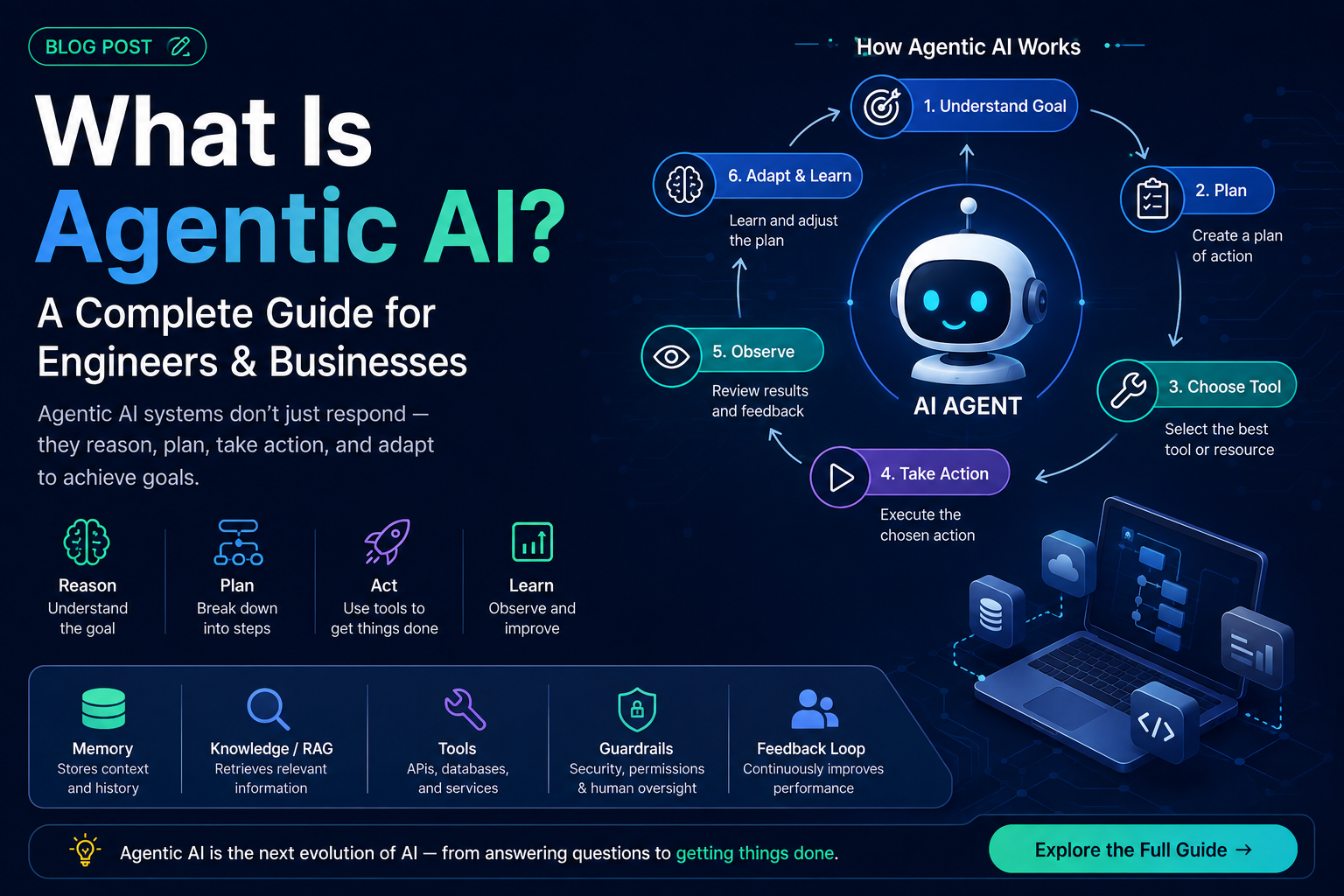
Direct Concise Answer
Agentic AI is changing how businesses think about artificial intelligence. Traditional AI systems typically respond to a prompt, generate an answer, or perform a predefined operation. Agentic AI goes further: it enables AI systems to work toward a goal by reasoning through tasks, using tools, accessing information, taking actions, evaluating results, and continuing through multiple steps with varying levels of human supervision.
This makes AI agents particularly useful for complex workflows where simply generating text is not enough. From customer support and sales automation to software development, research, data analysis, and enterprise operations, agentic AI is becoming an important architecture for building the next generation of AI applications.
What Is Agentic AI?
Agentic AI refers to AI systems designed to pursue goals through multiple steps, using reasoning, context, tools, and actions rather than simply generating a single response. An agentic AI system can follow a dynamic multi-step loop, participating in complex workflows that require access to data, tools, business rules, and external services.
AI Agents vs Traditional AI
Traditional AI typically goes from Input → Model → Output. Agentic AI is designed to understand a Goal, Reason, Plan, Select Action, Use Tool, Observe Result, and Continue or Change Plan until the Goal is completed. The agent has more responsibility for determining what needs to happen next, while operating within clearly defined permissions and human-approval boundaries.
How Does Agentic AI Work?
An AI agent typically combines several core components:
- Large Language Model (LLM): The reasoning and language component that decides what action to take next.
- Planning: The ability to coordinate multiple operations toward a larger objective.
- Tools: Capabilities to interact with external systems like databases, APIs, CRM, and email.
- Memory: Short-term memory for current interaction context and long-term memory for historical data.
- Retrieval and Knowledge (RAG): Accessing company documentation, procedures, or databases using vector search.
Agentic AI Architecture
A production agentic AI system is intentionally modular, consisting of an Application Layer, an Agent Layer (Goal Management, Planning, Reasoning), and foundational layers like Memory, Knowledge/RAG, and Tools that connect to External Systems. This allows teams to improve individual components without rebuilding the entire application.
The Agentic AI Loop
A useful mental model for an AI agent is the reason → act → observe → continue loop. This loop is what allows an agent to handle tasks that cannot be completed in a single model response.
What Are AI Agent Tools?
An AI agent becomes significantly more useful when it can interact with tools. Tools provide capabilities, the model provides reasoning and language, and the application provides orchestration and control. Examples include Web Search, Document Parsers, Knowledge Bases, and Report Generators.
Agentic AI and MCP
Model Context Protocol (MCP) is particularly relevant because it provides a standardized way for AI applications to connect with external tools and data sources. Instead of creating a completely different integration mechanism for every tool, developers can expose capabilities through MCP-compatible servers.
Single-Agent vs Multi-Agent Systems
Not every problem requires multiple agents. A single agent handling the entire workflow is simpler to develop. A multi-agent architecture divides complex workflows among specialized agents (e.g., Research Agent, Analysis Agent, Sales Agent). Use multiple agents because the problem requires them—not simply because multi-agent systems are fashionable.
Agentic AI vs Traditional Automation
Traditional automation generally follows predefined rules (IF-THEN). Agentic AI can handle more flexible workflows, determining appropriate approaches dynamically. For deterministic tasks, conventional automation is better. For dynamic tasks involving unstructured information, agentic systems provide greater flexibility.
How Can Businesses Use Agentic AI?
- AI Sales Agents: Lead qualification, personalized outreach, and CRM updates.
- Customer Support: Troubleshooting issues, creating support tickets, and searching knowledge bases.
- Software Engineering: Issue investigation, code generation, testing, and debugging.
- AI Research Agents: Source collection, document analysis, and report generation.
- Enterprise Knowledge Agents: Unifying information spread across databases, PDFs, and platforms.
- Small Businesses: Focused workflows like lead management and appointment booking.
How to Measure Agentic AI ROI
Businesses should define metrics before implementation. Potential metrics include response time, qualified leads, operational cost, and employee time saved. The important metric is not simply "How much AI did we deploy?", but rather "Did the system improve a measurable business outcome?".
Agentic AI Security
More autonomy means more responsibility. Important controls include Least Privilege, Authentication, Authorization, Input Validation, Human Approval, Logging, and Monitoring.
Human-in-the-Loop AI Agents
Fully autonomous systems are not always appropriate. A better architecture for many business workflows is to have the AI Agent prepare an action, wait for Human Approval, and then Execute. This provides a useful balance between AI automation and operational control.
How Engineers Can Build an AI Agent
- Define the goal: Start with a specific business problem.
- Define the workflow: Map out the exact steps required.
- Identify tools: Determine what external systems are needed.
- Define permissions: Set clear boundaries for Read, Write, and Approval.
- Build the agent: Combine LLM, tools, memory, RAG, and APIs.
- Evaluate: Test realistic scenarios and failures.
- Deploy with observability: Monitor outputs, failures, and business outcomes.
What Is the Future of Agentic AI?
The future involves systems that assist, use tools, execute workflows, and coordinate complex tasks. Greater autonomy creates greater engineering responsibility for security, observability, and robust failure handling. The winning applications will provide reliable value while keeping humans in control.
Frequently Asked Questions
What is an AI agent?
An AI agent is a software system that can use AI models, tools, context, memory, and external systems to accomplish a defined goal.
Can AI agents increase business revenue?
They can support revenue growth through lead qualification, personalized engagement, customer follow-up, sales assistance, and workflow automation. Actual results depend on implementation and business context.
Frequently Asked Questions (Agentic AI Sales)
Q: What is agentic AI?
Agentic AI refers to AI systems designed to pursue goals through multi-step reasoning, tool use, information retrieval, and actions rather than simply generating a single response.
Q: What is an AI agent?
An AI agent is a software system that can use AI models, tools, context, memory, and external systems to accomplish a defined goal.
Q: How are AI agents different from chatbots?
A chatbot generally focuses on conversation and responses. An AI agent can potentially perform multi-step tasks using tools and external systems.
Q: Can AI agents increase business revenue?
They can support revenue growth through lead qualification, personalized engagement, customer follow-up, sales assistance, and workflow automation. Actual results depend on implementation and business context.
Q: What is multi-agent AI?
Multi-agent AI uses multiple specialized agents that collaborate or coordinate to accomplish a larger task.

Sajjad Ahmad
AI Engineer based in Islamabad