Direct Concise Answer
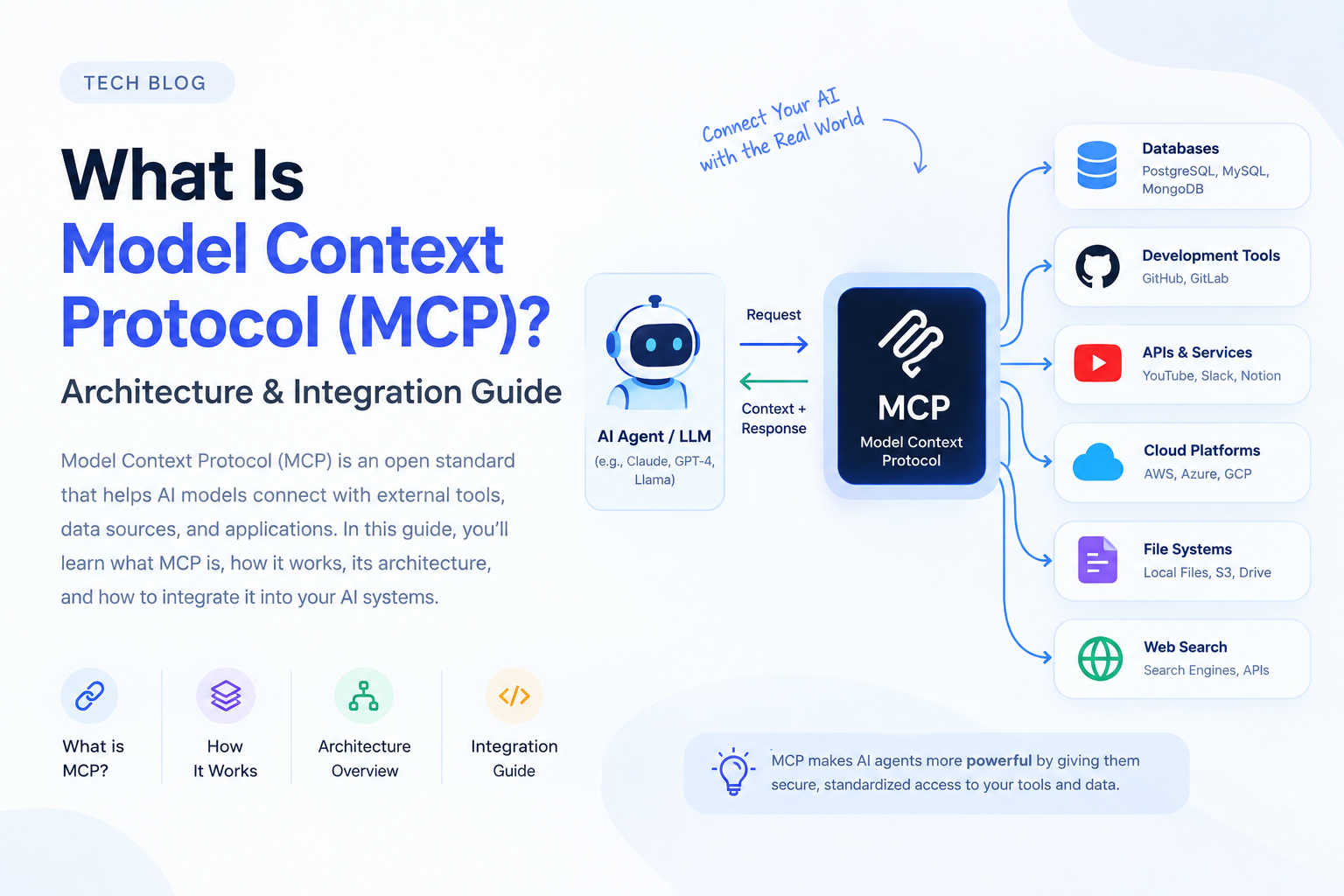
Model Context Protocol (MCP) is an open standard for connecting AI applications with external tools, data sources, and services. Instead of building a separate custom integration for every AI model and every application, MCP provides a common protocol through which AI applications can discover and use capabilities exposed by MCP servers.
For AI engineers, this matters because modern AI systems are moving beyond simple question-and-answer interactions. AI agents increasingly need to access databases, files, APIs, GitHub repositories, business systems, search services, and other tools to complete real-world tasks. MCP provides a standardized way to build those connections.
What Is Model Context Protocol (MCP)?
Model Context Protocol, commonly called MCP, is an open protocol designed to standardize how AI applications connect to external systems. An AI model by itself mainly operates on the information provided to it through its context. To perform useful tasks in the real world, however, an AI application often needs access to information and capabilities outside the model.
AI Coding Agent Needs
- Read files
- Search a codebase
- Inspect GitHub issues
- Query a database
- Call an API
AI Sales Agent Needs
- Search a CRM
- Retrieve customer info
- Check product availability
- Create a lead
- Schedule a meeting
Without a standardized integration layer, every application could require its own custom implementation. MCP addresses this integration problem by defining a common protocol for communication between AI applications and MCP servers.
Why Does MCP Matter?
Traditional AI applications often look like this: User → AI Application → LLM → Response. This works well for generating text, answering questions, summarizing information, or writing code. But real-world AI agents need something more: User → AI Agent → LLM → Tools + Data + APIs + Services → Real-world action.
Imagine asking an AI agent: "Find the latest sales leads, identify customers who have not been contacted in 30 days, and prepare a follow-up list." The model needs access to a CRM or database. MCP provides a standardized way for these capabilities to be exposed to AI applications.
MCP Architecture Explained
The easiest way to understand MCP is to think about three major components: Host, Client, and Server.
1. What Is an MCP Host?
The MCP host is the AI application that coordinates the overall interaction. It may be an AI coding environment, an AI assistant, an AI agent application, or an enterprise AI application. The host is responsible for coordinating MCP clients, managing user interaction, and integrating the model with the available MCP capabilities.
2. What Is an MCP Client?
An MCP client is the connector inside the host application that communicates with an MCP server. The client handles MCP protocol communication with its server. This separation is important because the AI application does not need to implement every external service directly.
3. What Is an MCP Server?
An MCP server exposes capabilities that an AI application can use. An MCP server might connect to PostgreSQL, GitHub, Google Drive, internal company databases, REST APIs, or local files. The server acts as the standardized interface between the AI application and the underlying system.
The Three Core MCP Primitives
MCP servers can expose three major primitives: Tools (Actions), Resources (Data), and Prompts (Instructions).
MCP Tools
MCP tools are executable functions that allow an AI application or model-driven workflow to perform actions or retrieve information. For example: search_github(), query_database(), or create_ticket().
MCP Resources
Resources provide data or contextual information to an AI application. Examples include files, database schemas, and documentation. A simple way to remember the distinction is: Tools do something. Resources provide something.
MCP Prompts
MCP servers can also expose prompt templates (e.g., /analyze_customer). This can help standardize common interactions between users, AI models, and connected systems.
MCP and AI Agents
MCP becomes particularly powerful when combined with agentic AI. An AI agent can work more like: Goal → LLM → Reason → Choose Tool → MCP → External System → Tool Result → LLM → Next Step → Action. MCP does not itself make an application autonomous. Instead, MCP provides a standardized interface through which an agentic application can access capabilities.
MCP vs APIs & Function Calling
MCP and APIs solve different problems. An API typically defines how one application communicates with a particular service. MCP provides a standardized AI-facing protocol for exposing tools, resources, and related capabilities. An MCP server can actually use existing APIs internally, sitting above existing APIs rather than replacing them.
MCP Transport and Communication
MCP messages use JSON-RPC 2.0 as the protocol message format. The current 2026-07-28 MCP specification made an important architectural shift toward a stateless protocol core, allowing remote MCP servers to operate more naturally behind ordinary HTTP infrastructure and load balancers. This is particularly important for production deployments because scalability, routing, caching, and infrastructure compatibility become easier to manage.
MCP Security: What Developers Need to Know
- Limit permissions: Only expose the tools the AI actually needs.
- Validate tool arguments: Never blindly trust model-generated parameters.
- Authenticate remote connections: Use appropriate authentication and authorization mechanisms.
- Protect sensitive data: Do not expose unnecessary credentials or secrets.
- Add human approval: For high-impact actions (e.g., deleting a customer), require human oversight.
How to Build an MCP Server
The basic development process involves identifying the system, defining capabilities, creating the server using an MCP SDK, defining tool schemas, connecting the underlying API, adding authentication, and testing the server before connecting it to an AI host. Learn more about how we can help build this with our MCP server development services.
Frequently Asked Questions
What is MCP in AI?
MCP, or Model Context Protocol, is an open standard that allows AI applications to connect with external tools, data sources, and services through a standardized protocol.
Can MCP be used with RAG?
Yes. MCP can provide standardized access to knowledge bases, documents, databases, search systems, and other sources used in RAG workflows.
Frequently Asked Questions (Agentic AI Sales)
Q: What is MCP in AI?
MCP, or Model Context Protocol, is an open standard that allows AI applications to connect with external tools, data sources, and services through a standardized protocol.
Q: What is an MCP server?
An MCP server is a service that exposes capabilities such as tools, resources, and prompts to an MCP client.
Q: What is an MCP client?
An MCP client is the connector inside an AI host/application that communicates with an MCP server.
Q: Is MCP an API?
MCP is a protocol rather than a conventional business API. It can provide a standardized AI-facing layer over existing APIs, databases, services, and other systems.
Q: Can MCP be used with RAG?
Yes. MCP can provide standardized access to knowledge bases, documents, databases, search systems, and other sources used in RAG workflows.
Q: Can MCP be used for AI agents?
Yes. MCP is particularly useful for agentic AI applications that need standardized access to tools and external data.

Sajjad Ahmad
AI Engineer based in Islamabad